

Most people who contact an estate litigation lawyer did not expect to need one. They expected the estate process to move quietly, according to what their loved one had expressed during their lifetime. Then something changed: a document surfaced that did not match what they were told, a sibling challenged the distribution, or they discovered they had been removed from a will they were certain they would benefit from.
Estate disputes are both more common and more consequential than people realize. They are also governed by strict legal deadlines that begin running before most families understand what is happening. Knowing when and how an estate litigation lawyer can intervene makes the difference between protecting what your loved one intended and losing that right by waiting too long.
Key Takeaways
- Estate litigation covers will contests, trust disputes, breach of fiduciary duty claims, and beneficiary designation conflicts
- Most disputes are resolved through negotiation or mediation rather than full court proceedings
- Arizona has strict statutes of limitations for will contests and trust challenges that cannot be extended
- An estate litigation lawyer represents both claimants asserting inheritance rights and fiduciaries defending their administration
- Early legal involvement consistently reduces both the cost and duration of estate disputes
What Falls Under Estate Litigation
Estate litigation is a broad term covering any formal legal dispute connected to the administration or validity of an estate, trust, or estate planning document. A look at how a trust attorney resolves inheritance disputes illustrates the range of conflicts this area of law addresses. The most common dispute types include the following.
Will Contests
A will contest is a formal legal challenge to the validity of a will. In Arizona, grounds for contesting a will include lack of testamentary capacity, meaning the testator did not understand what they were signing; undue influence, meaning someone manipulated the testator into changing the document; fraud, meaning the testator was deceived about the nature or contents of what they signed; and improper execution, meaning the will was not witnessed or signed correctly under Arizona law.
Trust Disputes
Trust disputes arise when beneficiaries disagree with how a trustee is administering the trust, when the terms of the trust are ambiguous, or when a beneficiary believes the trust was created or amended under conditions that make it invalid. These disputes can involve ongoing trusts where distributions are contested, or trusts that are being administered following a death.
Breach of Fiduciary Duty
Executors, trustees, and personal representatives all hold fiduciary duties to the estate and its beneficiaries. When they mismanage assets, fail to make required distributions, engage in self-dealing, or otherwise act outside their legal authority, beneficiaries have the right to bring a breach of fiduciary duty claim. These claims can result in removal of the fiduciary, surcharges for losses caused, and disgorgement of improper gains.
Disputed Beneficiary Designations
Assets that pass outside of probate through named beneficiary designations on life insurance, retirement accounts, or bank accounts can themselves become contested when the named beneficiary was changed shortly before death, when the change is alleged to have been made under undue influence, or when the designation conflicts with the terms of a will or trust.
Creditor and Claims Disputes
When creditors assert claims against an estate that beneficiaries believe are invalid, time-barred, or overstated, an estate litigation lawyer can contest those claims on behalf of the estate. Conversely, when legitimate creditors are improperly denied, the attorney can enforce their rights against the estate.
Why Estate Disputes Happen: The Most Common Causes
Understanding the root causes of estate litigation helps families recognize warning signs while there is still time to prevent a formal dispute. The table below summarizes the situations that most frequently trigger legal conflict:
| Common Cause | How It Leads to Litigation |
|---|---|
| Outdated Documents | Will or trust reflects a prior family situation, including deceased beneficiaries, property already sold, or marriages and divorces not properly addressed. |
| Blended Family Dynamics | Competing claims arise between biological children, stepchildren, and surviving spouses when estate documents do not clearly define inheritance rights. |
| Undue Influence Allegations | A beneficiary is accused of pressuring or manipulating the deceased to change estate planning documents, often during periods of illness or cognitive decline. |
| Ambiguous Will Language | Unclear or conflicting wording creates multiple interpretations, requiring court involvement to determine the deceased's intent. |
| Executor or Trustee Disputes | Beneficiaries challenge decisions regarding asset management, valuation, accounting, or distributions made by the personal representative. |
| Lack of Mental Capacity | A party argues the deceased did not have sufficient cognitive ability to understand the legal documents being signed. |

One pattern runs through nearly all of these causes: the absence of recently updated, clearly drafted estate planning documents. Disputes that begin from genuine confusion about what a loved one intended can almost always be traced back to documents that were not revisited after a major life change, or to language that was clear enough in the moment but became ambiguous years later.
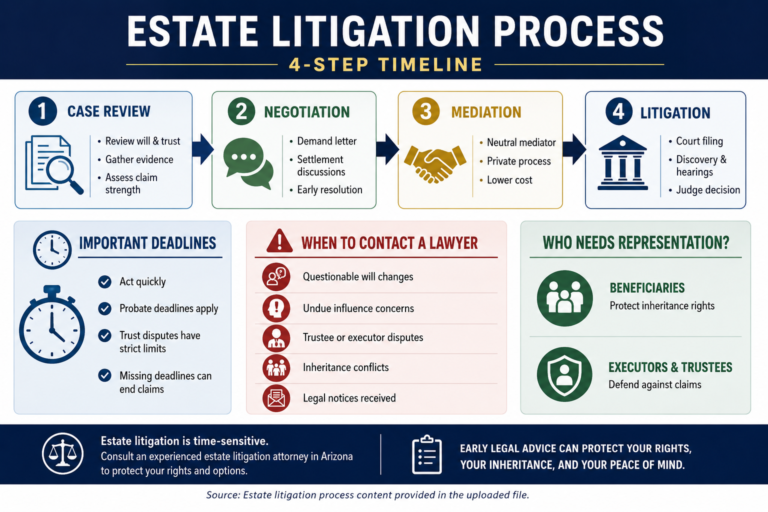
The Estate Litigation Process: What to Expect
A qualified estate planning lawyer in Arizona with litigation experience will begin by evaluating the strength and legal basis of the claim before recommending any action. Filing a challenge without a well-grounded legal theory is expensive and often counterproductive. The process moves through the following stages.
Initial Case Assessment
The attorney reviews all relevant documents, including the will, any prior versions of the will, trust documents, correspondence, medical records if capacity is at issue, and the timeline of events leading to the dispute. Based on this review, they assess whether the claim is legally viable, what evidence would be needed to support it, and what the realistic range of outcomes looks like.
Negotiation and Demand
Most estate litigation attorneys attempt to resolve disputes through direct negotiation before filing anything with the court. A demand letter outlining the legal position and proposed resolution is often enough to bring the other side to the table. Many disputes are resolved at this stage, particularly when the other party recognizes that their legal position is weak.
Mediation
When direct negotiation does not resolve the dispute, mediation brings in a neutral third party to facilitate a structured conversation between the parties. Mediation is faster, less expensive, and more private than court proceedings. It also allows both sides to reach a solution they actually agree to, rather than having a resolution imposed by a judge. The majority of estate disputes that proceed past initial negotiation resolve at mediation.
Formal Litigation
When all other options have been exhausted, when fraud or abuse of a fiduciary position is alleged, or when the rights at stake are significant enough that only a judicial determination will resolve them, the attorney files a formal proceeding with the Superior Court. Court proceedings in estate litigation involve discovery, depositions, expert witnesses in some cases, and ultimately a hearing or trial before a judge. This stage adds significant time and cost compared to earlier resolution.
For disputes involving a contested beneficiary deed in Arizona specifically, the process for contesting a beneficiary deed follows specific procedural rules and deadlines that differ from will contests. An attorney familiar with Arizona’s property transfer law will navigate these correctly.
Arizona Deadlines for Estate Litigation
The most consequential aspect of estate litigation from a practical standpoint is timing. Arizona law imposes strict deadlines for challenging wills and trusts, and courts do not extend these deadlines for reasons of convenience or unfamiliarity with the law.
For will contests in Arizona, a challenge must generally be filed within two years of the decedent’s death. However, once a will has been admitted to probate, the deadline shortens considerably. Certain trust challenges may have even shorter windows depending on when the challenger received notice of the trust’s terms. The deadlines are jurisdictionally specific and fact-dependent, which is why confirming them with an attorney immediately is the only safe approach.
If you believe you have a claim, contact a trust attorney in Chandler before taking any other action. Do not sign any settlement agreement, waiver, or release of claims without legal review. What appears to be a fair offer may extinguish rights that have significant value once properly evaluated.
Contact an estate litigation lawyer immediately if any of the following apply:
- You believe a will or trust was signed under circumstances that compromised the testator’s free choice or mental capacity
- You have been unexpectedly removed from or significantly reduced in an estate document you believed you would benefit from
- You are serving as an executor or trustee and are facing claims of mismanagement or breach of duty
- A beneficiary dispute has arisen that informal family conversation has not resolved
- You have received a demand letter or formal legal notice connected to an estate or trust
How an Estate Litigation Lawyer Can Also Protect Fiduciaries
Estate litigation is not only for beneficiaries asserting claims. Executors, trustees, and personal representatives are regularly named as defendants in disputes brought by beneficiaries who believe the estate was mismanaged. These claims can be unfounded and still be expensive and time-consuming to defend without proper legal representation.
An estate litigation lawyer who represents fiduciaries will review the administration record, identify any procedural gaps that need to be addressed, and mount a defense that demonstrates the personal representative fulfilled their legal duties. In cases where the fiduciary made an honest error, an attorney can often negotiate a resolution that limits personal financial exposure.
Frequently Asked Questions
Can I contest a will in Arizona after probate has already started?
Yes, but the window narrows once probate begins. Acting before the will is admitted to probate gives you more procedural options. Once admitted, the timeline tightens. Contact an attorney as soon as you have concerns rather than waiting to see how the process develops.
What evidence is needed to prove undue influence in an estate dispute?
Proving undue influence typically requires evidence of a close relationship between the alleged influencer and the deceased, evidence that the influencer had opportunity and motive, and a resulting estate document that benefits the influencer at the expense of natural beneficiaries. Medical records, communications, and witness testimony all play a role.
How long does estate litigation typically take in Arizona?
Disputes resolved through negotiation can close in weeks to a few months. Mediated resolutions typically take one to three months. Formal court litigation in contested estate matters routinely takes one to three years depending on complexity and court scheduling.
Can estate disputes be prevented through better planning?
Many of them, yes. Regular document updates after major life changes, clearly drafted trust and will language, explicit no-contest clauses in appropriate cases, and transparent communication with family members during life eliminate the conditions that most frequently produce litigation.
What is the difference between estate litigation and standard probate?
Probate is the routine court process for administering a deceased person’s estate. Estate litigation refers to disputes arising within or alongside that process, including challenges to document validity, claims against the fiduciary, or disagreements about distribution that cannot be resolved informally.
Taking Action Before a Dispute Gets Harder to Resolve
Estate disputes do not become easier with time. Evidence becomes harder to gather, witnesses become harder to locate, and legal deadlines approach faster than most families realize. The single most effective step anyone facing an inheritance dispute can take is to speak with an estate litigation lawyer immediately, before taking any other action in the estate.
Citadel Law Firm works with Arizona families on both sides of estate disputes: protecting the inheritance rights of beneficiaries and defending executors and trustees against unfounded claims. A free consultation provides a clear picture of your legal position and your options, without any obligation to move forward.